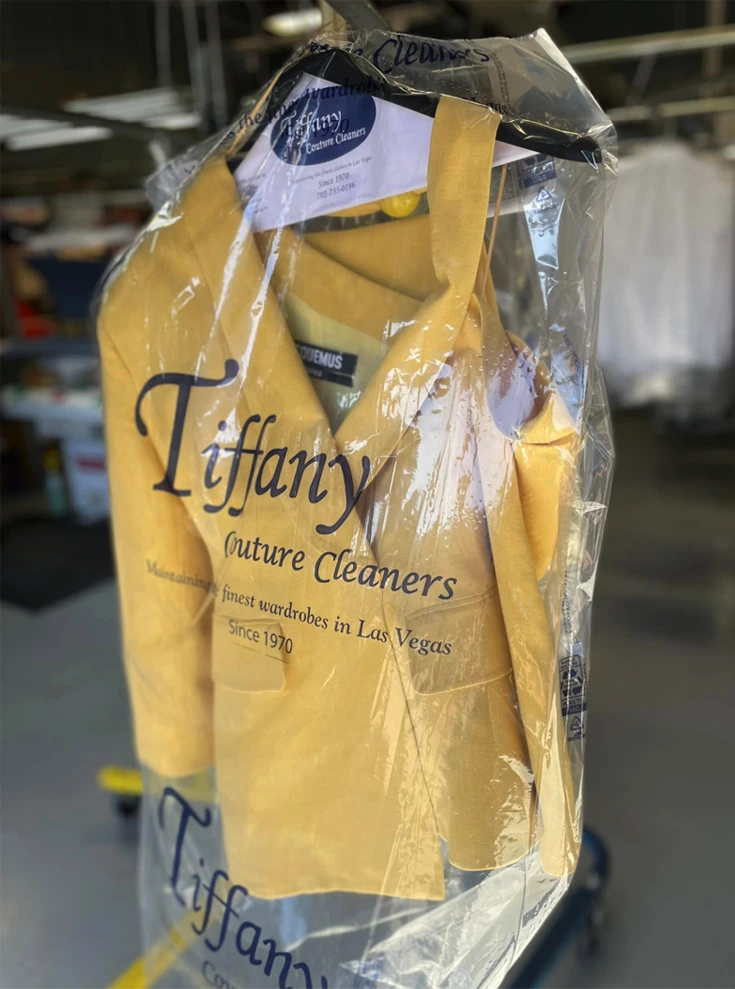
How to protect a wedding dress from damage starts with knowing what's actually happening in storage right now. If your wedding dress has been sitting in a closet, attic, or garage since the wedding, it's likely changing in ways you can't see yet. A sealed plastic bag traps moisture, a wire hanger reshapes the neckline, sunlight and temperature swings weaken the fabric, acidic boxes speed up yellowing, and invisible stains from cake or champagne darken over time.
None of this means the dress is ruined. It means the damage is happening quietly, and it's still preventable. Here's what to look for in your own storage, and what to do about it today.
That plastic bag in which your dress came home from the salon wasn't built for long-term storage. It was built to keep the dress clean on the car ride home. Left sealed for months or years, that same bag traps humidity against the fabric instead of letting it escape.
This creates the exact conditions mold, mildew, and yellowing need to take hold, especially inside a closed closet with little air movement.
The fix you can do today: Take the dress out of any sealed plastic immediately. Switch to a breathable garment bag, ideally cotton or muslin, even before you arrange full preservation. This one change buys you time.
Check these spots first, since they're where moisture problems usually show up earliest:
If you see any of these, don't try to treat them yourself. Home remedies often set the stain deeper into the fibers.
A standard hanger, wire or plastic, was never meant to hold a wedding dress. All that weight rests on two small points at the shoulders. Over months of hanging, that pressure stretches and distorts the shoulder seams and neckline, especially with heavier fabrics such as satin or a full ballgown skirt.
You won't notice this happening day to day. You'll notice it the next time you unzip the dress and the shoulders sit differently than they did on the wedding day.
Not every dress hangs equally. Ballgowns, dresses with multiple layers of tulle, and dresses with heavy beadwork put far more strain on the shoulder seams than a simple sheath silhouette. If your dress falls into any of these categories, the damage from hanging happens faster than you'd expect.
Flat, boxed, or padded support built for the actual shape and weight of the garment is the only real fix, which is part of what proper wedding dress preservation sets up correctly from the start.
Two separate risks live in this category. Light exposure, even indirect light through a window or a bright hallway, fades color and weakens fibers over time. Temperature and humidity swings do something different. They cause fabric to expand and contract repeatedly, which speeds up fiber breakdown and yellowing far faster than storage in a stable, climate-controlled space.
If your dress is sitting in an uncooled garage or attic here in Las Vegas, the swing between desert heat outside and whatever temperature that space holds is more extreme than in most parts of the country. A garage that hits well over 100 degrees Fahrenheit in summer and cools significantly overnight puts your dress through daily stress for which most storage advice doesn't account. A closet inside the air-conditioned part of the house is a meaningfully safer short-term option than a garage or attic.
Standard moving boxes and the tissue paper from the department store are almost always acidic. Prolonged contact with acidic materials speeds up the same oxidation process that causes yellowing, separate from the moisture damage covered above. This is a slower process than the humidity issue, but it's just as permanent once it sets in.
Acid-free tissue and boxes aren't a marketing upgrade. They're chemically inert, meaning they don't react with the fabric or transfer any acidity into it over time. That's the entire difference: standard materials actively contribute to yellowing, while acid-free materials simply don't interact with the dress at all. It's a small material swap with an outsized effect on how the dress looks years from now.
This is the risk most brides don't expect. Sugar from cake or champagne, body oils, and perspiration don't show up as visible stains on the wedding day or even the week after. They sit invisibly in the fabric, and over months or years, they oxidize and darken into stains you can see, even if none of the other four risks above ever come into play.
A dress can look perfectly clean under normal light and still carry these residues. The problem only becomes visible once oxidation has already occurred, at which point it's a much harder stain to remove than it would have been the week after the wedding. Cleaning before storage, not after damage appears, is the step most brides skip entirely, and it's often the single biggest factor in how a dress looks years down the line.
Everything above is a separate risk with a separate cause: moisture, pressure, light, acidity, and invisible residue. You can address a couple of these on your own with a breathable bag or a better closet spot. What you can't easily replicate at home is a process that handles all five at once.
Professional wedding dress preservation cleans the dress to remove invisible residues, uses acid-free archival materials throughout, and seals the dress in a stable, climate-appropriate environment built specifically for long-term fabric storage. It's not that your dress is already ruined. Most of this damage is slow, and slow damage is still preventable if you act before more time passes.
Every risk covered above shares one thing in common. It targets the details you worked hardest to get right, the fabric, the beadwork, the shape of the neckline. Catching it now, before it sets in, is far easier than trying to reverse it later.
At Tiffany Couture Cleaners, we treat every dress as a one-of-a-kind piece, with handling aligned to luxury and couture standards. Our wedding dress preservation process is built to protect delicate fabrics, intricate construction, and fine detailing from exactly the risks outlined above, so nothing about your dress is left to chance.
Your wedding dress has waited long enough. Schedule your assessment with us today and give it the care it was always meant to have.
Address: 4205 S. Grand Canyon Dr., Suite #1, Las Vegas, NV, 89147
Phone: +1 702-842-0103
Email: info@tiffanycc.com
A couture gown and a cotton shirt should never go through the same cleaning process, yet at most cleaners, they do. The difference between a garment that comes back looking cared for and one that comes back merely clean usually comes down to a handful of decisions made before, during, and after the actual cleaning, decisions a standard cleaning operation isn't built to make on a per garment basis.
Here's what a genuinely qualified couture cleaner actually does differently, and how to tell the difference before you hand over a piece that can't be replaced.
Couture and delicate garments aren't built like everyday clothing. Unusual fibers, hand-applied embellishment, and structural elements, such as boning, interfacing, and internal linings, all respond differently to heat, moisture, and agitation than a cotton shirt or a pair of trousers. A standard cleaning process is built for volume and consistency, not for reading what a specific garment needs.
The stakes are real. The wrong solvent on the wrong fiber can shrink a jacket permanently. The wrong dry cycle can pull dye out of a silk blouse, and a structured piece can lose its shape in a single pass through equipment that wasn't designed with it in mind. Once that happens, there's no undoing it, and pieces like these usually can't be replaced off a rack.
Not every nice garment falls into this category, and not every delicate garment looks obviously fragile. Pieces that need specialized handling typically include:
If a garment combines more than one of these elements, it needs more than a standard cleaning cycle to come out looking the way it went in.
Before any cleaning method is chosen, a qualified couture cleaner identifies what they're actually working with. That means checking fiber content, weave, dye stability, and the garment's structural elements, rather than defaulting to whatever process handles most of what comes through the door that day.
This step is invisible to the customer. You won't see it happen, and you won't get a receipt for it. But it's where most of the risk in cleaning a delicate garment gets caught, or missed entirely.
A cleaner who skips this step doesn't cut a corner you'll notice right away. They cut the step that determines whether or not your garment survives the process intact.
A thorough pre-cleaning inspection typically covers:
Different fabrics call for specific processes. Traditional dry cleaning solvents work well for some fibers and poorly for others. Wet cleaning suits certain garments better than dry cleaning ever could. Some pieces need to be hand cleaned entirely, with no machine involvement at all.
A specialist chooses based on what the individual garment requires. A standard cleaner, working at volume, often runs one process for nearly everything that comes in, because that's what keeps their operation efficient. Efficiency and precision aren't the same goal, and for couture pieces, precision is what matters.
Think of it less as a single cleaning method and more like a set of tools, where the skill is in choosing the right tool for the piece in front of you. A silk gown, a wool blazer, and a beaded cocktail dress can all arrive in the same week and leave through three completely different processes. That's not an inconsistency. That's the process working the way it's supposed to.
This is where the difference between a standard cleaner and a specialist becomes something you can actually picture. Embellished garments need attention before cleaning even starts, not just careful handling once the process is underway.
A qualified cleaner hand inspects embellished areas first, checking for loose beads, sequins, or trim, and reinforces anything that came unsecured before the garment goes anywhere near a cleaning process.
From there, embellished sections are often masked off or hand cleaned separately from the base fabric, so the treatment suited to the beading doesn't damage the fabric around it, and vice versa. Machine agitation, which can catch, pull, or shed delicate trim in seconds, is avoided entirely in these areas.
This reinforcement step is worth understanding on its own, because it's easy to overlook. A single loose thread holding a row of beads in place can unravel further under any agitation, even gentle handling.
Before cleaning, securing that thread makes a big difference to your beaded hem. It's the difference between arriving home intact or missing a section you didn't realize was loose in the first place.
Cleaning is only half the job. How a garment is finished afterward determines if it looks cared for or just processed. A flat commercial press works fine for a dress shirt. It does not work for a structured jacket, a pleated skirt, or a gown with a fitted bodice.
A qualified couture cleaner form presses garments over pads or forms shaped to match the piece's own structure, rather than flattening everything against a single surface. Details a machine press would distort, such as pleats, structured shoulders, and delicate collars, are hand-finished instead, with attention to how the garment was originally constructed to move. These are the delicate garment cleaning tips that separate a piece that looks merely cleaned from one that looks genuinely cared for.
The equipment matters here as much as the technique. Specialized presses, shaped forms, and hand irons suited to fine fabrics all exist because flat, high heat, high pressure equipment simply wasn't designed for garments with dimension.
A jacket pressed over a properly shaped form comes back with its shoulders sitting the way they were cut to sit. The same jacket run through a flat press comes back technically clean, and visibly flattened.
That's the real difference between a garment that's been cleaned and one that's been cared for: it looks pressed by someone who understood how it was built, not just run through a machine that got it clean.
You don't need to understand solvents or pressing equipment to evaluate a cleaner. You just need to ask the right questions and pay attention to the specific answers. Learning how to care for couture clothing starts with knowing which of these questions your current cleaner can actually answer.
A cleaner who answers these specifically, by name, for your exact garment, tells you something. A cleaner who gives you a version of how they handle all fabrics tells you something, too.
You've read what separates real expertise from a standard cleaning cycle. If you now wonder whether or not your own cleaner actually meets that bar, that instinct is worth listening to.
At Tiffany Couture Cleaners, we've provided luxury dry cleaning service to Las Vegas's most refined wardrobes since 1970. Every garment is inspected, sorted, and cleaned using our SYSTEMK4 green cleaning process, chosen specifically because it protects fabric integrity, structure, and finish on luxury and couture pieces. We don't run one process for everything that comes through the door. We identify what your garment needs, then clean accordingly.
Bring in your piece and let us show you the difference, by name, not by generic quote.
Address:4205 S. Grand Canyon Dr., Suite #1, Las Vegas, NV, 89147
Phone: +1 702-842-0103
Email: info@tiffanycc.com
The yellow ring on your collar isn't there because you haven't washed the shirt enough. It's there partly because of how you've been washing it. Hot water, extra detergent, the dryer on high – each of these feels like the logical response to a stain that won't quit, and each accelerates the problem.
The compound responsible for collar yellowing doesn't respond to heat and detergent. It bonds to the fiber because of them. Here's what actually causes it, what makes it worse, and what finally removes it.
Two things combine to create that yellow ring, and neither is about being unclean.
01) Body oils and sebum.
Your neck produces natural oils continuously, day and night. Every time you wear the shirt, those oils transfer into the collar fabric, and they don’t just sit on top of the fibers. They work their way in.
02) Aluminum compounds from antiperspirants.
Most antiperspirants rely on aluminum salts to block sweat. Those compounds migrate onto fabric from your neck and underarms. On their own, they’re not a major issue. But once aluminum compounds meet the proteins in sweat and body oil, they form a bond that grips onto cotton and synthetic fibers, one water and regular detergent can’t break.
The staining itself isn’t the yellow color that comes later. Once the oil and aluminum compound bonds into the fabric, repeated trips through the washer and dryer expose it to heat and oxygen, and it oxidizes. That’s a chemical change, not dirt building up, which is why regular washing makes the stain worse instead of better.
The most important rule is no heat on a stained collar. Not hot water, not the dryer, not the iron. Heat is the single biggest factor in turning a stain you could still remove into one you can’t.
A few specific habits to watch for:
Re-washing an already-stained collar without changing anything else just repeats the same heat exposure that caused the problem. If the water’s warm and the dryer’s hot, another wash cycle isn’t neutral; it’s another round of oxidation.
The fix isn’t washing more. The fix is to treat before you wash, and keep heat away from the stain until it’s gone.
Pretreat the collar while it’s still dry. This is the step almost everyone skips. Applying a treatment to a wet collar dilutes it instantly and cuts its effectiveness way down. Always treat dry fabric first.
A few methods that work, depending on what you have on hand:
Check the collar before it ever sees a dryer. If any trace of yellow remains after washing, treat it again; don’t dry it “just to see.” Drying a shirt with an active stain still on it heat-sets whatever’s left, even if the stain looks faint. Repeat the pretreatment and cold wash until the collar comes out clean, then dry.
Home treatment works well on stains caught early. Once a collar has been through ten or more wash and dry cycles with heat involved, the compound is set deeper, and results from home methods get less predictable.
Professional shirt laundering approaches the problem differently:
For Las Vegas professionals who wear white dress shirts regularly: given the desert climate and the resulting perspiration levels, collar staining accumulates faster here than in cooler markets.
Professional shirt laundry every few wears, even alternating with home washing, prevents the repeated heat exposure that turns manageable early-stage staining into set staining. It’s far easier to maintain a clean collar than to reverse one that’s fully set.
If you’ve tried every trick at home and that yellow ring is still there, it’s not your effort that’s falling short; it’s what regular washing can do. At some point, a stain stops being a laundry problem and becomes a job for professional equipment and treatment.
We’ve built our Shirt Laundry Service around exactly this kind of problem. Every shirt that comes through Tiffany Couture Cleaners receives individual attention – collars treated before cleaning, buttons checked, and each piece pressed and finished so it’s genuinely ready to wear, not just clean. We treat your everyday shirts with the same care we give our luxury garments, because consistency is the whole point.
If you’re searching for Shirt Laundry Service near Las Vegas, Nevada, bring in your shirts and let us take the stains off your hands.
📍 4205 S. Grand Canyon Dr., Suite #1, Las Vegas, NV, 89147
Your wedding dress is not a blazer or a linen shirt. The fabrics are delicate – made of silk, organza, chiffon, and lace. The construction is complex, with boning, multiple layers, and embellishments that require individual attention. One wrong treatment during cleaning is permanent.
Wedding dress cleaning is a specialized service, and not every dry cleaner has the experience, equipment, or processes needed to handle delicate bridal fabrics properly. That's why choosing the right specialist is worth the extra effort.
This guide covers five specific, easy-to-spot qualities that can help you identify a qualified wedding dress cleaning professional with confidence.
Many dry cleaners that advertise wedding dress cleaning don’t perform the work themselves. They ship the dress to a third party processing facility, sometimes out of state. The local shop is essentially a middleman with limited visibility into what actually happens to your dress.
A specialist who cleans on site is directly accountable for every step. The dress doesn’t travel. It doesn’t change hands multiple times. One party is responsible from drop-off to pickup.
What a good answer sounds like:
What a bad answer sounds like:
When a dress is shipped out for cleaning, more handling events increase the risk of transit damage, zipper snags, compression wrinkles, and mishandled embellishments. A locally cleaned dress also means a shorter timeline between drop-off and pickup, and a clearer path to recourse if a concern arises after you get the dress back.
This is the step that separates specialists from shops that just accept wedding dress cleaning as a category. Before any cleaning begins, a qualified specialist examines the dress under appropriate lighting, identifying all staining, noting fragile areas, and documenting embellishment types and fabric composition. Then they talk to you about what they found.
A good pre-cleaning conversation covers:
Wedding dresses regularly carry colorless soils that are completely invisible when the dress comes off, i.e., perspiration, body oils, and sugar compounds from champagne or cake. These don’t show up on your wedding night. They show up six months later as yellow discoloration on a dress already in storage.
A specialist looks for these specifically during the inspection and addresses them in pretreatment. A generalist processes the dress through a standard cycle and returns it, with the slow-developing damage already underway.
Genuine expertise shows up in specificity. Ask a specialist how they approach different fabric types, and a real professional will give you different answers for each.
Ask this directly:
“How do you handle a silk charmeuse dress differently from an organza or tulle-heavy dress?”
What the answers should tell you:
A generalist says, “We handle all types.” A specialist says why each type requires a different approach.
Add this to your conversation:
“How do you handle a dress with extensive beading or sequin work?”
Beading and sequins may be glued or sewn, and glued embellishments can loosen or dissolve on contact with certain solvents or water if not treated individually. A specialist knows which adhesives are vulnerable and addresses them before cleaning begins. A generalist often doesn’t check.
Cleaning is only part of the job. How the dress is boxed afterwards determines whether that wedding dress cleaning holds up over the years, or undoes itself in storage.
Archival preservation means:
Ask directly: “Is the tissue acid-free, and is the box pH-neutral?” A specialist answers specifically and can show you the materials. “We use quality materials”, without specifics is not a sufficient answer.
Nevada’s desert climate creates specific risks for stored textiles that humid climates don’t carry. Low ambient humidity causes unprotected fabric to become brittle over time. High UV intensity accelerates color degradation, even through windows. Regular tissue paper is acidic. Standard cardboard boxes release compounds. Plastic bags trap moisture and create their own damage.
Archival boxing addresses all of these risks specifically, which is why it isn’t optional for Las Vegas brides storing their dresses long term.
A specialist confident in their work can tell you exactly what happens if the outcome falls short. A shop that can’t answer this question clearly isn’t prepared for that possibility.
Ask this:
“What’s your policy if a stain can’t be fully removed or if there’s a concern after pickup?”
A good answer names a specific resolution process and a timeframe for raising concerns. “We’re very careful” is not a policy; it’s a reassurance that sidesteps accountability.
Follow up with: “Do you carry garment insurance for high-value items?”
Las Vegas weddings span a wide range of dress values, from heirloom dresses to designer and couture pieces that can represent $3,000 to $10,000 or more. Most professional cleaning operations carry garment care coverage. A specialist should confirm this without hesitation. If they can’t, that’s worth noting before you hand over the dress.
At Tiffany Couture Cleaners, we treat each dress as an individual piece. We personally inspect your dress for visible and invisible staining before we clean, hand-spot treat every stain with the method appropriate for your specific fabric, and pack your dress in acid-free, museum-quality archival materials after cleaning. No shortcuts. No third party handoffs. We do the work here.
If you’re ready to work with a Las Vegas wedding dress cleaning specialist who’s built their practice around bridal care, we’d love to take care of your dress.
📍 4205 S. Grand Canyon Dr., Suite #1, Las Vegas, NV, 89147
🕒 Monday through Friday, 7:00 AM to 7:00 PM
Saturday, 9:00 AM to 5:00 PM
Sunday: Closed